Showing posts with label CAD. Show all posts

Interesting Stengel Engineering Feature

I just posted an interview with Andreas Wild Stengel Engineering (an interview feature started back in September) to Coaster101. What really intrigued me was his response to this question: "At what stage in the creation of an amusement park attraction does Stengel Engineering become involved?"


And his response " ...sometimes the layout shows dramatically false guesses (in terms of accelerations, clearances, etc.) and we have to redesign the layout entirely. Sometimes this is too late to redo things completely and we have to find a compromise which works for all parties." 


Wow! Could he be referring to Intamin projects such as Maverick where they had to remove an entire inversion element? Or Millennium Force where they screwed up the clearance envelope by placing some of the roller coaster's supports too close to the track (pictured below)? I think so. Do you?

Read the full  interview here.

Omega Tau Podcast Appearance

I recently was interviewed for the Omega Tau podcast (science and engineering in your headphones). You can listen to me ramble about roller coasters here. I'd like to extend my thanks to Markus for inviting me to appear on his show to talk about different aspects of roller coasters.

Omega Tau episode 86 Roller Coaster Design

How to design a roller coaster book

If you’re an avid fan of Roller Coaster Tycoon or No Limits coaster simulations then you may really enjoy this new book. Have you ever wondered what it takes to design and build a roller coaster? At last, there's a book that shows you. Coasters 101: An Engineering Guide to Roller Coaster Design examines the numerous diverse aspects of roller coaster engineering, including some of the mathematical formulas and engineering concepts used.


This technical guide is the most detailed roller coaster design book to date and will take you through the entire process, from concept to creation. A must read for every enthusiast and aspiring roller coaster engineer!

 I'll be talking about roller coasters on an upcoming episode of the Omgea Tau podcast (science and engineering in your headphones).

Purchase the eBook Kindle edition from Amazon.

Six Flags Goliath Train Rendering

Six Flags New England has posted some great renderings of the new 4-across trains designed by Premier Rides that will be put to use on Goliath (formerly Deja Vu at Six Flags Magic Mountain) when it opens. One of the first questions in the comments is what type of software did they use to create the 3D CAD model? Well, to my untrained eye, it looks very much like a SolidWorks model.

One of the most common questions asked by aspiring roller coaster engineers is what software do roller coaster designers use. I already pointed out that Dynamic Structures use AutoDesk Inventor while it appears S&S Worldwide and Premier use SolidWorks.

Learn more about roller coaster design software.

Cantilevered Coaster V3 Preview Video

I've been modeling a new chassis configuration for the cantilevered roller coaster. Here's a quick preview video. Sorry for the bad quality. Hopefully we'll have a full track layout next time.

S&S Worldwide's new thrill ride

Blooloop recently posted a fantastic interview with a vice president from S&S Worldwide. What really caught my mention was the talk of a new ride described as a thrill version of the Free Fly coaster, which will offer a new sensation to the industry, and be exclusiveto S&S. Here are the known facts directly from the article:

  • ...we have a new concept but you will not see it out in the open.
  • It is a thrill version of our Free Fly “family” coaster, capable of a truly unique ride sensation never before experienced and exclusive to S&S...
  • ...we’ve patented the mechanical piece that creates the ride experience. 
  • We vetted the idea with significant people in the industry last year at IAAPA and over the year.
  • ...a new product, especially one of the caliber we are introducing, S&S is making a statement: beyond being creative...
  • ...we have partnered with an engineering firm in Southern California that specializes in aerospace and government contracts, and have additional tools and engineering resources we don’t.  This union has created a feasibility study and product analysis I doubt has ever been done before. 
  • ...decision to bring in the best talent, worldwide, to create, engineer and validate not only the ride, but also the effects the ride experience has on the human body. 
  • ...the ride concept, which has a “4th-dimension type ride experience” but at half the cost of a 4D coaster, is extreme and thrilling beyond previous experience...
What really got my attention from the above information was the fact they have already patented the concept. Knowing this, I scoured the internet to try and find this patent. Well, I didn'tfind any new patents related to S&S Worldwide or any of their engineers but this didn't exactly surprise me because it sounds like they want to keep this under wraps. 

However, after an extensive search, I believe I found the patent and the type of ride system they could be talking about here. It doesn't have a name that I know of at this point so I am going to dub it "the gyro-coaster."  


The seat assembly is capable of fully rotating about a first axis, secondaxis, and third axis independent of the track system. The rotation can be free or controlled. Each individual vehcile assemblycould have a different degree of motion than the other vehicle assemblies. The launch tower concept looks pretty cool too!


Here's the evidence that leads me to believe this is the ride we are looking for.
  • The patent was filed in 2009. S&S discussed the idea at the IAPPA show in 2010, thus the timeline works out and makes sense.
  • The patent attorney's office is in Salt Lake City, Utah, not far from S&S headquarters.
  • The inventor resides in Southern California (and presumably works for the hired engineering firm). I couldn't find any other information on the inventor, which is odd.
  • When S&S Arrow filed the patent for the 4d coaster they used James Sonntag as their patent attorney, thesame person who shows up on this new patent. 

Is this all just coincidence? I have no idea if it actually is butthe evidence would lead me to believe we are looking at new ride concepts from S&S Worldwide. You can see why they would bring in anotherfirm to do analysis- some pretty complicated dynamics there! If this is true, I am really excited by this design concept. The possibilities are endless; the humanbody being the major limiting factor. What are your thoughts?


How to Design a Coaster

Sneak Peak at Upcoming Project

I'd like to apologize for not postinganything substantial lately. I have been busy writing an article for Coaster Critic as well as working on a project whichI will share the details on in due time. For now, here is a little sneakpeek preview.

 Can you guess what it is?

The Amazing Adventures of Spiderman ride layout

I love looking at ride layouts or diagrams. If you've ever wondered what the overheadride layout of the Amazing Adventures of Spiderman at Universal's Islandsof Adventure looks like this is the best one I've seen. Attached is a diagramof what is probably the layout, at least it looks like it is pretty accuratefrom what I can remember. It's a very disorienting ride. Number 50 is theunload and load stations. How does Spiderman work? The ride basically usesa six axis Stewart platform  mounted to a vehicle chassis with the added ability to rotate dueto a ring and pinion gear system. Attached are a few drawings from thepatent for this amazing amusement ride vehicle.


Please vote for the cantilevered coaster design

I would really appreciate it if you would consider voting for my design in CATIA's 2011Visualization contest. The cantilevered coaster is a revolutionary concept pushing the thrill ride to the next level of unpredictability and excitement by utilizing two tracks which follow different courses causing the vehicle to swing in a side to side yaw movement, pitch front to back, and an up and down vertical stroke. Please vote for me here.

Roller Coaster Maintenance and Mechanical Components Handbook

Have you ever wondered what a work instruction manual for a roller coaster entails? First of all, what am I even talking about? Well, a roller coaster or amusement park ride manufacturer creates a manual of how to safely operate and inspect their thrill machine. This is basically a work instruction book given to the park and contains all of the preventive maintenance steps as well, safe operating procedures, and anything else needed to maintain the ride. Some of these handbooks even contain mechanical drawings and engineering calculations!

So what does one of these manuals look like? Well, it just so happens that I have been able to find one on the internet and will share it with you. You can download the pdf here. You might learn a thing or to about how a roller coaster works! Be sure to check out some of our other diagrams.

Roller Coaster Maintenance and Mechanical Components Handbook.pdf download

Software used at ThinkWell Theme Park Design


What computer software programs do roller coaster designers use?


Today, roller coasters are designed using the latest in computer technology. The universal tool for the engineer that has completely ruled out the classic drawing board is CAD (Computer Aided Design) software. Programs such as AutoCAD are used to draft, adjust and detail bents in accordance with ride standards. Some companies employ proprietary software which optimizes the track  layout at the computer using elaborate numerical algorithms to help keep the g-forces on the passengers below required safety or customer defined limits. Computer programs can analyze dynamic and static calculations for the track, and automatically determine where supports should be placed.
3D CAD software, such as CATIA or Solidworks, now allows designers to have every aspect of thrill ride design all within one software program including 3D models, 2D manufacturing drawings, kinematic simulations, finite element analysis (FEA), and image renders for marketing purposes. Standard parts like bolts, springs, nuts, washers can be taken from standard part libraries or catalogs and bills of material can be derived directly from the model and inserted into a drawing.
Utilizing this type of software is an enormous improvement over methods that were employed even twenty five years ago. The time required to create a ride would be great without using a computer because of the enormous number of calculations required. Changes and iterations can be made much faster using the computer. Rides can also be built to higher standards, quality, and tolerances. Modern 3D CAD systems can help the engineers design the ride within the limits of biodynamic tolerances of the passengers. A simulation of the coaster can be done based on the CAD data, and so the forces and the dynamic behaviour can be determined way before a prototype has been built. The roller coaster is virtually assembled early in the design phase to test functional relations and mechanisms as well as collision detection of components and clearance envelope. When the CAD work is complete the production data is electronically sent to the manufacturer.

Latest Cantilevered Coaster model video update

Check out the status on my Cantilevered roller coaster concept model. I completed some of the fine details for the main course like the cross-ties, support columns, and cement footers. I also attempted to make a banked track section, which turned out OK minus the rails which look bumpy, twisted, and are generally terrible. Refinement coming your way!

My 3D Model in PRISM Magazine

My 3D Model in PRISM Magazine


I received a copy of the November issue of PRISM Magazine the other day. Flip to page three and what do I see? My model of the cantilevered roller coaster sponsored by Dassault Systems! PRISM magazine is ASEE's monthly publication (the American Society for Engineering Educators).

S&S Spaceshot CAD Model Recreation


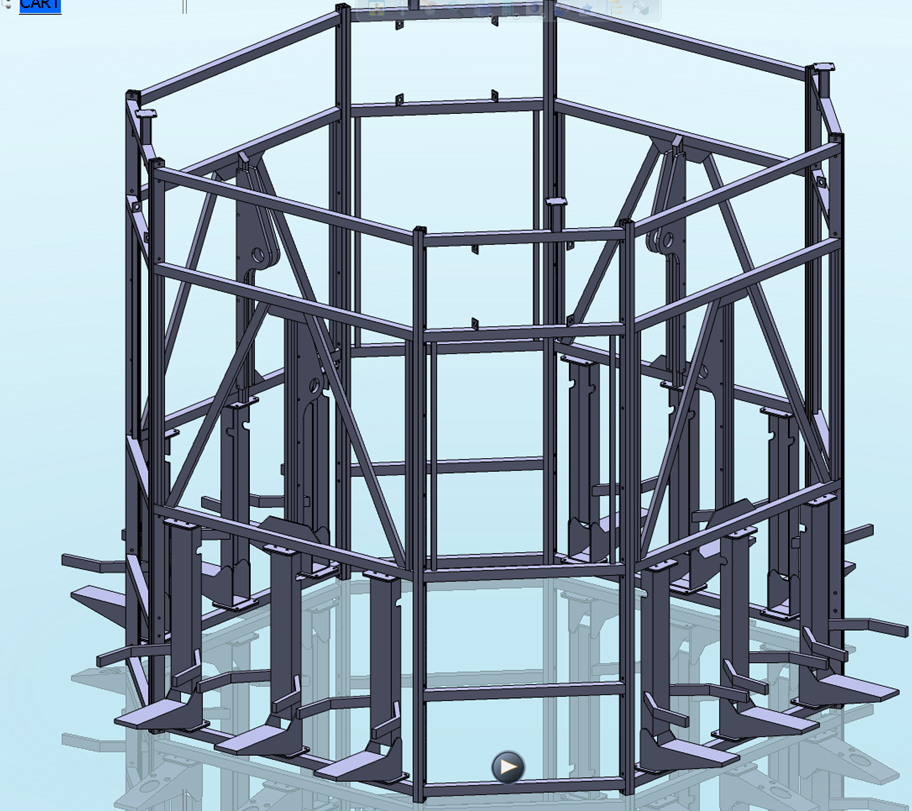
I started a 3d computer model recreation of a 3x3 size Spaceshot launched thrill ride attraction engineered by S&S Worldwide.